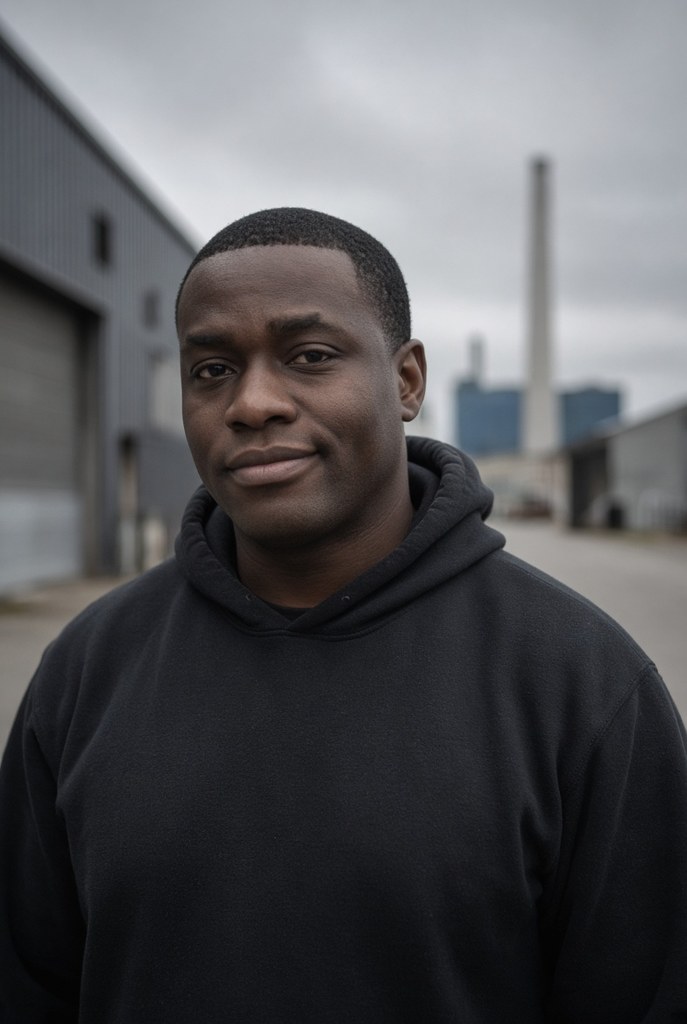
Milwaukee Marcus
 | |
| Era | The 2000s |
|---|---|
| Age | 30-37 |
| Home | Milwaukee, WI |
| Demographic | Black, warehouse work, Midwest city |
| Lean | Lean Democrat |
| Race | black |
| Predecessor | Brownsville Deon |
| Successor | Brooklyn Jamal |
Marcus is a forklift driver on Milwaukee's north side, representing Black working men in a Midwestern city losing its industry. He votes Democratic when he votes, trusts no politician, and is the one Black voter in the cast the Republicans have reached, on school vouchers.
Who they stand for
Milwaukee lost its factories faster than almost any other American city, and by the late 2000s roughly half of the city's working-age Black men had no job. The Tower Automotive plant, previously known as A.O. Smith, closed in 2006. The Milwaukee Parental Choice Program, running since 1990, was the country's first school-voucher scheme. Black parents in the city supported it, while teachers' unions and most Democrats opposed it, and it is the one Republican-backed argument Marcus has accepted. In 2004 Frank Jude Jr. was beaten by off-duty Milwaukee police officers. A state jury acquitted the officers in 2006, the city's north side marched in protest, and federal convictions followed afterward. Black voter turnout rose through the decade, and in 2012 it passed white turnout nationally for the first time, though Marcus's own vote is among the least reliable part of that surge.
In the lineage of personas, nobody asks the young Black man in this line for his opinion until the 2010s, when universities and nonprofit organisations begin recruiting his successor. Marcus is the generation in between. He is cynical, votes only occasionally, and is reached by no institution except the school-voucher programme.
Playing to them
Marcus responds well to a manufacturing job, affordable health insurance, the school-voucher programme kept in place, police disciplined publicly for misconduct, a raised minimum wage, and a president who pays attention to his community outside election season. He will not forgive an unpunished police beating, a factory closed without a fight, a trade deal with China, a disaster response as slow as the one after Hurricane Katrina, or the death penalty. Neither party's culture-war issues reach him. A Republican can hold his attention on vouchers but loses it on everything else. A Democrat holds his vote but rarely his turnout.
Winning Marcus's support on trade costs Country Club Whit, Startup Seth, Abilene Ray and Fremont Anjali. Winning it on vouchers costs Protest Paige and Beltway Meredith, defenders of public schools. Winning it on police discipline costs Security Mom Donna, whose own family serves on the force. Greensboro Jasmine carries similar grievances but votes reliably every election, so a president who already has her support has done most of the work needed to win Marcus too. Sister Loretta is the church that would organise Marcus to the polls, if he still attended it.
Where they live
The five states where Milwaukee Marcus makes up the largest share of the electorate in the 2000s:
- Washington DC
- Mississippi
- Louisiana
- Maryland
- Georgia
Lineage
Brownsville Deon → Milwaukee Marcus → Brooklyn Jamal
The young Black man, who goes from ignoring politics to organising, because universities and nonprofits began recruiting young Black men in the 2010s. Deon does not vote and is consulted by nobody. Marcus is cynical and votes when he votes. Jamal is admitted to a university and hired by a nonprofit, becomes a community organiser, and writes about Black Lives Matter in a way Deon never would have. He is Pete's opposite. Institutions shut the young white man out and recruit the young Black man, and both become political because of it.