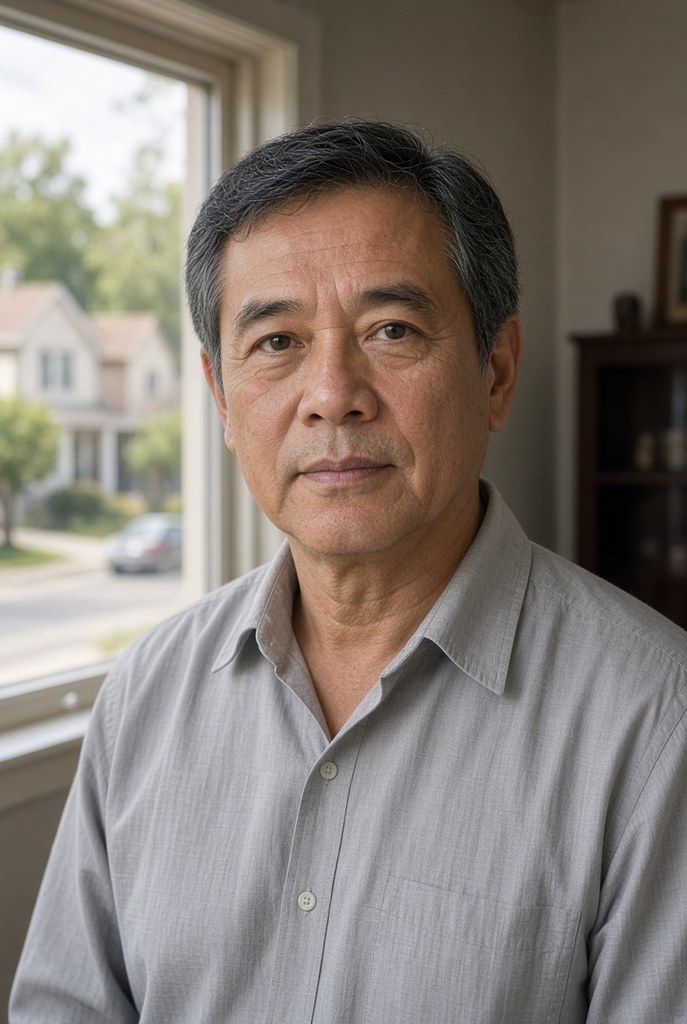
Little Saigon Tuan
 | |
| Era | The 2000s |
|---|---|
| Age | 50-59 |
| Home | Westminster, CA |
| Demographic | Vietnamese refugee, small business, Orange County |
| Lean | Lean Republican |
| Race | asian |
| Predecessor | Koreatown Daniel |
| Successor | Edison Chen |
Tuan is a former officer in the South Vietnamese military who rebuilt his life as a small-business owner in Orange County, California, representing refugee Republicans since the fall of Saigon in 1975. He leans Republican on taxes and admissions, and cannot be moved on communism.
Who they stand for
Westminster and Garden Grove, both in Orange County, hold the largest Vietnamese population outside Vietnam. In the 2000s, Vietnamese-Americans were the most Republican Asian-American group in the country. This outlook was formed by the fall of Saigon in 1975 and the refugee camps that followed, and it was renewed by two later events. The first was Clinton's normalisation of relations with Hanoi in 1995, read as a betrayal. The second was the 1999 Hi-Tek protest, when a video-store owner displayed the flag of communist Vietnam and thousands marched for fifty-three days. In 2004 Van Tran was elected to the California State Assembly, the first Vietnamese-American state legislator in the country. John Kerry, with his 1971 testimony against the Vietnam War and his later work normalising relations with Hanoi, was the Democrat this community would never support. Vietnamese families run most of California's nail salons, and backed Proposition 209, the 1996 measure banning affirmative action. By 2012 the second generation voted Democratic while the first still did not.
In the lineage of personas, the politics of each generation are fixed by one event. Tuan's successor experiences no such event, and drifts toward being a swing voter over admissions and immigration.
Playing to them
Tuan responds well to a hard line against the government in Hanoi, human rights conditions in every trade negotiation, the war on terror presented as a fight against tyranny, low taxes, less regulation of small business, admissions decided on merit, and respect for legal immigration. He will not forgive a president who embraces the Vietnamese government, speaks favourably of the anti-war left, extends racial preferences, or regulates businesses like his nail salons. Amnesty offends him because he employs immigrants who came legally. A Democrat can win his support only through Vietnamese human rights policy, without criticising the war itself.
Winning Tuan's support costs the cast's supporters of affirmative action, such as Greensboro Jasmine, Sister Loretta, Protest Paige and Berkeley Leonard, and its immigrant Democrats, such as Bakersfield Jesús, Mesa Ruben and Las Vegas Marisol, on illegal immigration. Startup Seth agrees with him on taxes but parts ways on the Patriot Act. Hialeah Gladys is a similar voter shaped by the loss of a different country, and her political identity is firmer than his, because her enemy, Fidel Castro, is still in power and still named. Fremont Anjali shares his views on admissions and nothing else.
Where they live
The five states where Little Saigon Tuan makes up the largest share of the electorate in the 2000s:
- Hawaii
- California
- Nevada
- Washington
- New Jersey
Lineage
Koreatown Daniel → Little Saigon Tuan → Edison Chen
Asian small-business owners, for low taxes and against affirmative action in all three decades. For Daniel and Tuan the politics come from one event each: the Los Angeles riots for Daniel, the fall of Saigon for Tuan. For Chen there is no such event, and his politics are about his children's university admissions. He has moved from lean Republican to swing because the Republicans still agree with him on admissions but now talk about immigrants in a way that includes him, and because he supports abortion rights.