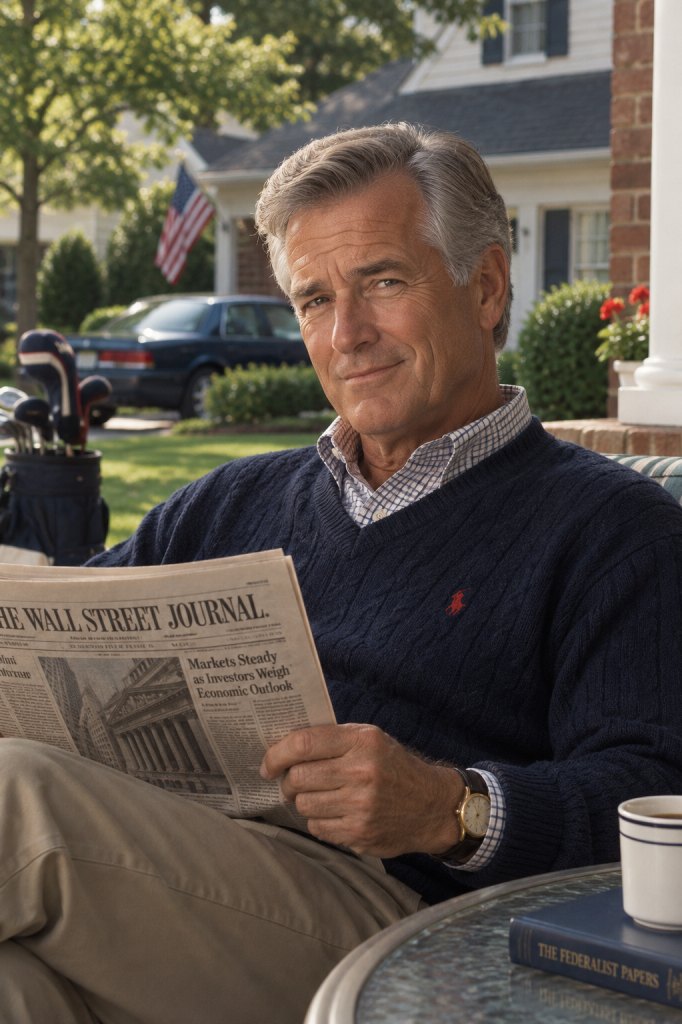
Country Club Chip
 | |
| Era | The Nineties |
|---|---|
| Age | 58-75 |
| Home | Greenwich, CT |
| Demographic | suburban white, business Republican, affluent |
| Lean | Lean Republican |
| Race | white |
| Successor | Country Club Whit |
A retired insurance executive in Connecticut's richest suburb, a George H. W. Bush Republican who reads the Wall Street Journal and belongs to the country club. He represents the party's business wing at the moment it begins losing the party to the populists.
Who they stand for
The Northeastern business Republican was the voter that the 1990 budget deal and its tax rise were designed to satisfy. Pat Buchanan's primary challenge to President Bush in 1992 was also directed at him. Ross Perot took nearly a fifth of the national vote in 1992, and much of it came from men like Chip. The Republican majority elected under Newt Gingrich in 1994 moved the party's centre of gravity to the South. Chip agreed with Clinton on NAFTA and on the balanced budget agreement of 1997. He agreed with his own party on little except the capital gains tax rate. His congressional district elected the moderate Republican Christopher Shays. Fairfield County voted for Clinton in 1996 and for Gore in 2000. Senator Jim Jeffords left the Republican Party in May 2001.
His economic views resemble Dot-Com Drew's, but he does not share Drew's contempt for institutions. He belongs to the same party as McPherson Don, but not Don's fear of free trade. His successors are Country Club Whit in the 2000s and Country Club Craig in the modern era. His own political views do not change across the eras. It is the Republican Party that moves away from him.
Playing to them
He supports deficit reduction, free trade, a low capital gains tax rate, keeping NATO intact, and a president who behaves with restraint. He does not need to agree with a president on abortion or guns. He only wants not to be lectured about them. He opposes tariffs, deficit spending presented as stimulus, a president who mocks the rich or the educated, and any prominence given to the religious right. His vote matters less to a campaign than the money he donates. His favourability affects how much money a campaign can raise, and a Republican who loses his favourability sees fundraising decline before opinion polls show any change. A fiscally cautious Democrat can hold him, as Clinton did on trade.
Winning him on free trade loses McPherson Don and Ozark Wayne. Winning him on capital gains loses Madison Steph and North Philly Arlene. Balancing the budget through spending cuts loses Baltimore Kiana and Mingo County Crystal. He and Plano Kimberly cannot both be satisfied by the same speech.
Where they live
The five states where Country Club Chip makes up the largest share of the electorate in the nineties:
- Connecticut
- New Jersey
- Delaware
- Pennsylvania
- Ohio
Lineage
Country Club Chip → Country Club Whit → Country Club Craig
The one line where the man does not change and the party does. In every decade he is fiscally conservative, for free trade, indifferent to social issues, and embarrassed by the populists and the religious right. Chip's wing of the party loses to Buchanan. Whit's has Bush and loses him over the deficit and the Christian right. Craig's has Trump and votes for him reluctantly. The same reluctant Republican vote three times.